
Hello everyone!
Amongst the many things I’ve been doing over the last two weeks is that we’ve re-arranged the furniture in our sitting-room. And that means taking all the books off one set of shelves, going through them and sifting out those I intend to sell (to World of Books) or gift to the charity shop. Then putting back the ones I kept on the shelves that are now in a different area of our room.
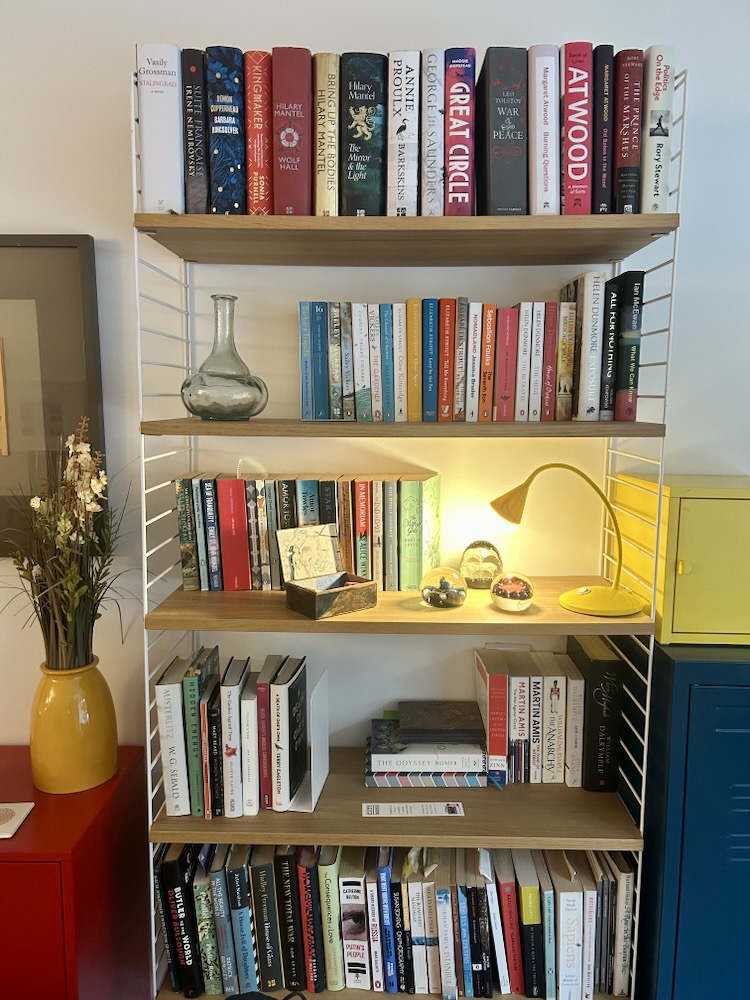
The books I kept were the ones I might not necessarily read again, but they were what I thought were very good reads, so they are the ‘keepers’. Btw, selling can be quite profitable as I had two books that both came to over £5 – woo hoo!
I read somewhere that shelves full of the books that you keep over the years tell you who you are. I agree with that and like looking at the ones that really touched me. I still think that Barbara Kingsolver’s Demon Copperhead was one of the best books I’ve ever read. It’s so clever. The David Copperfield tale, with every single one of Dicken’s characters transposed and relocated to Arkansas. I just lapped that book up with such relish, although you need to understand that, at the same time, it is a hard read of poverty and opioid addiction in the States. I found it a complex, fascinating, wonderful read.
Then I have the Hilary Mantel, Wolf Hall trilogy in hardback. These are near to Vassily Grossman’s Stalingrad, plus at the other end of the shelf, three by the great (what else can you call her) Margaret Atwood. Her latest is A Memoir of Sorts, but I think I prefer Burning Questions where, set out for you to read, are all her essays written throughout her life on every aspect you can imagine. Read it and feel your mind expand. What a woman, what a writer.
But, I didn’t start this blog post off with the intention of going through all the books on my shelves! Instead this is the blog where I tell you about the 7 books I read on holiday in Dungeness. The first book is my ‘book of the year’, and I have no doubt about that. It is Lifeboat at the End of the World. A Volunteer’s story, by Dominic Gregory. Oh wow, what a book. It is so beautifully written. This is a detailed depiction of what it is like to volunteer on a lifeboat. Btw, for those of you living outside the UK, our lifeboat service is totally manned by volunteers. It tells you of the very detailed training they all undergo. There is also some history of the ‘institution’, as lifeboat volunteers call it, and, would you believe it, there’s also much history of Dungeness. This is because the author is not only a lifeboat man, he lives in Dungeness and this is his story of joining and working for the Dungeness lifeboat service. I naturally had to read it whilst there. I cannot stress enough not only how beautifully it is written, it also describes many ‘shouts’.
Furthermore, towards the end of the book he describes the very challenging task they have picking up and saving the lives of the refugees that are coming across the English Channel (which can, at times, be a very nasty sea indeed) in flimsy blow-up boats that are not fit for purpose. For instance, some of the boats have chipboard bottoms that eventually fold up and collapse whilst still at sea. My view is that his description of these incidents is very morally upright – I cannot think of any other way to describe it – and it brought me near to tears. Lifeboat men and women are such heroes going selflessly out to sea in all conditions just to save lives. If you think differently I urge you to read this post in My Other Blog where I put the facts out – not the stupidity that gets tossed around in some areas of social media and amongst a couple of appalling (and fairly new) political parties. Apologies, end of rant.
I was so struck by the book I made my other half read it (while in Dungeness) and each of us now send a monthly subscription to the RNLI, plus I bought my Christmas cards from them as well.
Well that was a long ‘review’ but that book has just got to me. The second book, is the latest from Emily St John Madel – Exit Party. Madel is the author of Station Eleven, which I read some years ago. Because I was so enamoured with Exit Party I immediately read, Sea of Tranquility by Mandel – it’s not as good, as Exit Party.
It’s difficult to tell you the plot of Exit Party apart from there are two parallel worlds with a number of people moving from one world, their world, to a different but parallel world. If I tell you any more, it just kind of gives it all away. You need to find out about this book for yourself. But truly, I found this book utterly gripping. Mind you, there’s no skimming this book. (I do that a lot.) You have to concentrate. I liked this book more because of that. I skim books that bore me or are too easy to read. This book is not boring!
The third book I read was Summertime by JM Coetzee (found at Wi-wurri, Dungeness) Now this is a tricky one, as it is memoir in the form of a novel. It’s the third instalment of Coetzee’s trilogy Scenes from a Provincial Life (following Boyhood and Youth). The novel has an English biographer researching the author J Coetzee, who is dead. He interviews various people who had encounters, affairs or worked with this Coetzee. My word, the researcher (the author?) paints an unflattering picture of this Coetzee. I guess what the actual author is saying that committing to the artistic life has its costs, especially to social, emotional and personal relationships.
I’m wondering if I’m selling this but it was a very good read, and I felt fascinated by the whole premise of this memoir/novel.
The fourth book was A Life’s Work by Rachel Cusk: on Becoming a Mother (found at Wi-Wurri, Dungeness). Oh wow. Yes, it was a book that made me go – WOW! And why? Because it is an excoriating description of becoming a mother. Everything is raw, everything is laid out, and every single word tells of her deeply felt angst about being mother. She notes the physical events, and the emotional toll that birth and motherhood takes. And she writes about her love for her child. My word it struck a chord with me. I kept saying, yes, yes, that’s how it was for me. She described motherhood exactly as I remembered it. I recognised myself and felt recognised, as I too found it a profound shock to be a mother. My shock wasn’t about the physical challenge (and I wanted to be a mother) but the emotional toll, and the intensity of motherhood. That was what I recognised. Btw, you can probably see from this paragraph that there is no plot, it is just an exploration of her feelings about motherhood.
I could not put this book down. I was practically breathless as I read it.
The fifth book, Motherland, by Ann McFerran (found at Wi-Wurri, Dungeness) was chosen because I needed to read it after Cusk’s book! This book is a delightful read, so delightful that once home I bought a copy for myself. Published in 1998 it consists of interviews with mothers and daughters. And if you are my age (80) and a Brit you will recognise most of the interviewees. These range from Sheila Hancock and her daughter; Meera and Surrender Syal; Pat and Rachel Whitbread and, oh my heart, the wonderful Michele Hanson (columnist at The Guardian), her mother and her daughter Treasure (Amy) Hanson. And many more. I loved every single interview and it repaired my breathlessness (see above!) and reminded me of all the good times I had as a mother of young children. And incidentally, the author is the owner of Wi-Wurri.
The sixth and seventh books are non-fiction and all about Dungeness. These were Nanny Goat Island, Dungeness Then and Now by Keith Swallow, and Dungeness Coastal Architecture by Dominic Bradbury. Both are such good reads. I’ve owned a copy of Nanny Goat Island since 2023 but I take it with me to Dungeness every year and never tire of reading about Dungeness’s origins, which are very unique, as is the architecture found in this tiny part of England. This book on the buildings in Dungeness was a new one and we both read it during the week we were there. The photographs within the book are superb and it was interesting to hear of original neglected shacks, bought for a song, and transformed by architects. In particular, there was one architect who converted first the Coastguard Station and lived in it with her partner and children and then moved and refurbished the Experimental Station, a very severe brick-built set of one-story buildings. These were originally built by Trinity House and later bought by a hot-air balloon man who used the station to store his balloons and equipment. The buildings still look the same on the outside, but inside, the interiors are simply stunning.
And that is it. All 7 books read in one week.
I was rather stunned by that, as I take a long time to read just one book when at home. I thought about this and realised exactly why that is so. It’s quite obvious why I take such a long time to read a book. I don’t give much time at all for reading. It’s usually done late in the evening during our wind-down time which is from 9.0pm to 11.0pm, and if the book is boring (for whatever reason) I start falling asleep after a few pages. So we decided that at least a couple of days a week we would read earlier, from after our evening main meal. Dear reader, have we done that? Nope, we have not. We have gone back to our usual routine of watching the tv. We are quite dedicated watchers of quality tv dramas (Slow Horses, The Diplomat, for example) and documentaries – but strictly only 2 hours of tv and never after 9.0pm. It is all streamed, so it is our choice.
Another discussion took place in the middle of writing this blog! We start tonight – which will be a reading evening – woo hoo!
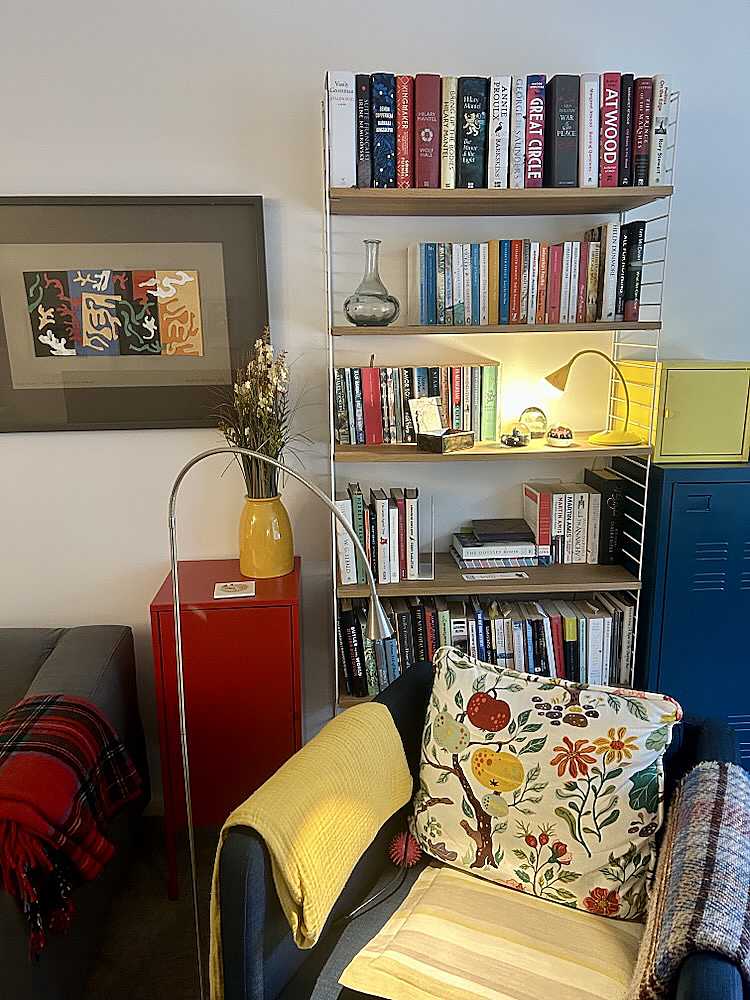
And that is where I will sit.
That’s really all for now. With love PennyX

